
Event Design - Event Layout
- Jose Martinez Juarez
- Jul 5, 2024
- 3 min read
"Everything fits in a little jar, if you know how to accommodate it"
Mexican Proverb

We have already discussed how each space has a natural vocation that allows us to take advantage of its characteristics, an essential part of our work as organizers is to work on an efficient and optimal distribution of these spaces.
It is important to consider in all event distribution the location of emergency exits, hydrants and be aware that the distribution must always protect the physical integrity of the people who will participate in the event.
This takes on special relevance in fairgrounds and convention centers since these generally receive the visit of the civil protection area of their locality, these agents visit the events regularly to ensure that the pre-established rules for these spaces are being complied with, and with the forecasts delivered and declared directly and previously by the organizer to the authority.
Remember that emergency meeting points and evacuation directions should be made known to attendees, ideally at the start of the event, as well as having proper signage at key locations.
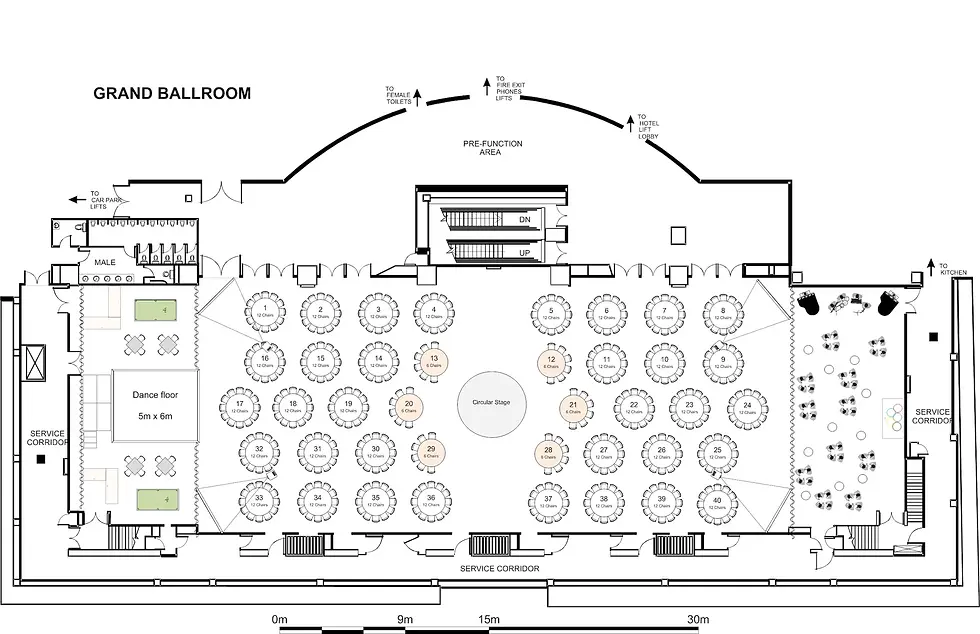
We can choose different types of emplacements to organize and event. Below, I present the most common arrangements for events.
Auditorium: the seats are arranged emulating a theater.
Banquet: the places are arranged around round tables with capacities of 8, 10 or 12 people; in some occasions the "crescent" sit-in is used, which consists of occupying only half of the seats available at the round table, thus allowing greater visibility when making a visual presentation or when there is a presidium.

Classroom: Seats are arranged in rows with tables to facilitate writing and placement of materials to be used during the event.
Horseshoe: Tables are arranged forming letters (U, E or T) and the seating places for the attendees are arranged around them, this arrangement seeks to provoke greater interaction between all attendees.
Russian Table: A square is formed with the tables, placing the chairs around, leaving an empty space in the center; It is an ideal setting for corporate events where the interaction of the attendees is sought to be equitable.
Free seating: the seating arrangement does not follow any specific accommodation; creativity is the rule.
In the case of some conventions and congresses, it is customary to integrate a commercial area or mini-trade show as part of the event, in which case its position must be strategically located so that the attendees can visit it during the coffee breaks.

In the case of the trade shows, the distribution is planned mainly under the logic of commercialization, that is, boots are distributed so that sales are easier.
Leading companies' booths are usually located in the front row or at the entrance of the trade show, however, my recommendation is to look for a distribution that allows different areas of interest and flow of visitors to prevent subsequent areas from losing interest and being more difficult to sell. One idea is to place activations or convince anchor companies to locate in these areas in exchange for some benefit granted by us.
In product presentations, press conferences and any corporate event it is important to have designated areas for important clients, high-ranking executives and specialized press; this way we will ensure that VIP attendees can appreciate and enjoy the event to the fullest.


Comments